Cosmetic
A decision guide comparing eyelid surgery and facelift — what each addresses, where they overlap, and when they are combined.
Medically reviewed by Andrew M. Goldbaum, MDOculoplastic SurgeonLast updated June 2026
Few cosmetic decisions confuse patients more than choosing between blepharoplasty and a facelift. The two procedures address entirely different anatomic regions, yet patients routinely arrive in consultation pointing to the same area of their face and asking which one they need. The short answer: blepharoplasty rejuvenates the eyelids, and a facelift rejuvenates the mid and lower face. They are not interchangeable, they rarely substitute for one another, and the most natural results often involve doing both — in the right sequence, by the right specialists.
This guide breaks down what each procedure actually does, where their territories overlap, why so many patients misidentify the source of their tired or aged appearance, and why an ASOPRS fellowship-trained oculoplastic surgeon should lead the periocular component of any plan — whether or not a facelift is also part of it.
Blepharoplasty is eyelid surgery. It corrects changes in the skin, muscle, and fat of the upper and lower eyelids — structures that sit within the orbital rim. The procedure does nothing to the cheek, jawline, neck, or brow. Its sole territory is the eyelid platform and the immediate periocular tissue.
Upper eyelid surgery targets dermatochalasis — the redundant skin that develops as the eyelid loses elastic recoil. In moderate to severe cases this skin drapes onto the eyelashes, obscures the natural crease, and can encroach on the superior visual field. Surgery removes a calibrated ellipse of skin, conservatively addresses orbicularis muscle when needed, and selectively trims or repositions the medial and central (preaponeurotic) fat pads if they bulge, while carefully distinguishing a prolapsed lacrimal gland (which should be repositioned, not excised) from fat. The goal is a refreshed, open eye — not a hollow, surgical look.
Lower eyelid surgery addresses fat pseudoherniation (the “bags” under the eyes), skin laxity, and the deep tear-trough hollow at the lid-cheek junction. Modern techniques emphasize repositioning fat over the orbital rim rather than removing it, which preserves volume and prevents the hollow, skeletonized appearance that plagued lower lid surgery of past decades. A transconjunctival approach — through the inside of the eyelid — avoids any external scar.
Patients with prominent under-eye hollowing alone — without true bags or excess skin — are often better candidates for hyaluronic acid fillers or fat grafting than for surgery.
A facelift — technically a rhytidectomy — rejuvenates the mid and lower face by repositioning soft tissue that has descended with age. Despite its name, a traditional facelift does not address the eyes, the forehead, or the upper third of the face at all. Its anatomic zone begins below the cheekbone and extends to the jawline and upper neck.
A modern deep-plane or SMAS facelift addresses:
The incisions run in front of and behind the ear, sometimes extending into the hairline and behind the earlobe. Recovery involves significant swelling and bruising across the cheeks and neck for two to three weeks, with full settling of results over several months.
Important: A facelift will not improve hooded upper eyelids, under-eye bags, crow’s feet, or a heavy brow. Patients who undergo a facelift expecting eye rejuvenation are routinely disappointed.
Between the lower eyelid and the cheek lies a transition region that is genuinely contested territory. This is where blepharoplasty and facelift surgery can both legitimately operate — and where the wrong choice produces the most disappointing results.
The lower eyelid does not end at a clean anatomic boundary. It blends into the cheek through the tear trough medially and the malar region laterally. As patients age, three things happen simultaneously in this zone:
A pure lower blepharoplasty addresses the first issue and partially the second. A midface lift — which can be performed by an oculoplastic surgeon through a lower lid approach — addresses the descent component directly. A traditional facelift pulls primarily on the lower face and contributes little to this zone.
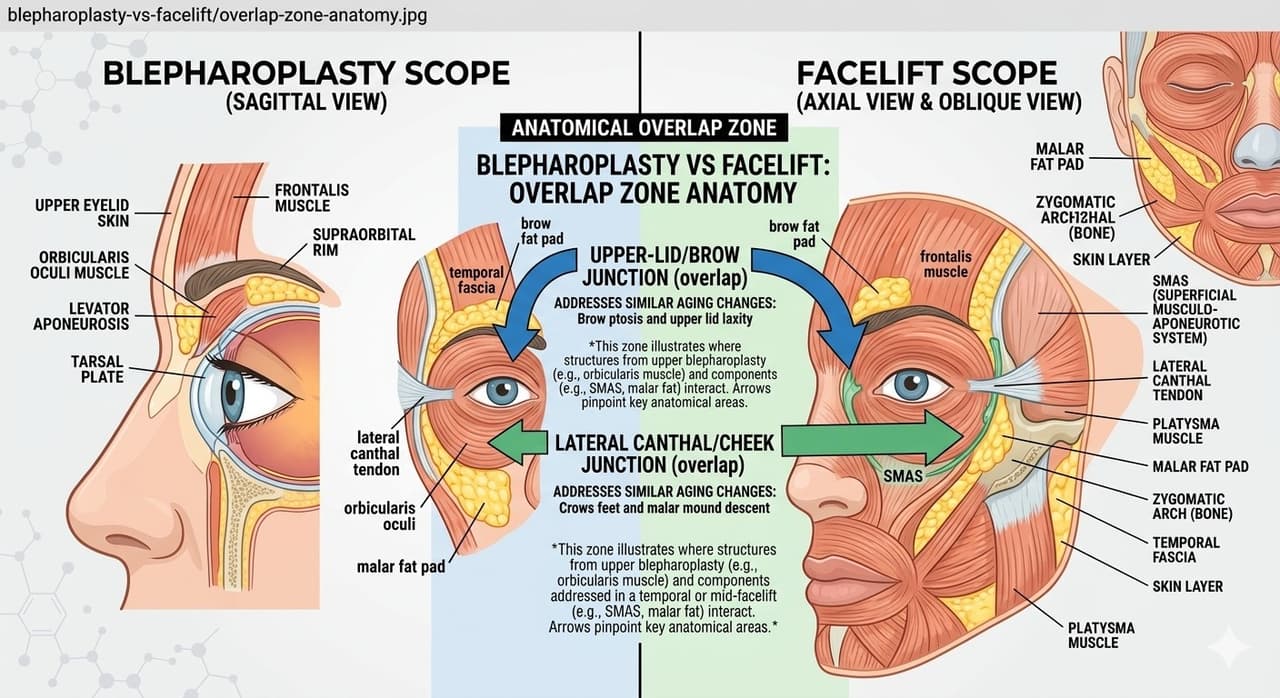
The lateral upper face is another zone of confusion. A heavy lateral brow contributes to upper eyelid hooding but cannot be corrected by blepharoplasty alone — it requires a brow lift. Crow’s feet at the lateral canthus are primarily dynamic rhytids best treated with neuromodulators, with skin resurfacing as an adjunct for static lines, rather than excisional surgery.
The confusion is understandable. When a patient looks in the mirror and sees a tired, aged face, they often cannot localize what specifically has changed. The brain perceives the gestalt — “I look older” — without isolating which anatomic region is responsible.
A useful exercise: in front of a mirror, gently lift the skin at the temple upward and outward with your fingertips. If your eyes look refreshed, your concern is largely periocular — blepharoplasty (often combined with a brow lift) is your procedure. Now place your fingers in front of the ears and lift up and back. If your jawline and lower face look rejuvenated but your eyes still appear tired, you have a separate facelift question. Many patients see improvement in both maneuvers — meaning both procedures may be appropriate.
For patients in their late fifties through seventies, combining blepharoplasty with a facelift in a single surgical session is common and often ideal. The procedures address non-overlapping anatomy, the recovery periods overlap so the patient only takes time off once, and a single anesthetic is more efficient than two staged operations.
When both are planned, the surgical sequence matters. Upper blepharoplasty is typically performed first while the face is undistorted by facelift swelling, allowing accurate skin marking. Lower blepharoplasty is coordinated with any midface component so that tissue planes are not violated unnecessarily. The facelift is generally performed after the eyelid work is complete.
This is where specialty boundaries matter. A facial plastic surgeon or plastic surgeon performs the facelift. An ASOPRS-trained oculoplastic surgeon performs the blepharoplasty. In many practices these are different physicians collaborating in the same operating room or in coordinated staged procedures. Some surgeons perform both, but patients should always ask about specific fellowship training in eyelid surgery — the eye is a uniquely unforgiving anatomic region.
Even when a facelift is the primary goal, the eyelid component should be evaluated by an oculoplastic surgeon. Lower lid complications — ectropion, retraction, dry eye — are far more common when periocular surgery is performed by surgeons without dedicated eyelid training.
The two procedures differ substantially in invasiveness, recovery timeline, and cost. Patients trying to decide between them — or planning to combine them — should understand these practical differences.
| Factor | Blepharoplasty | Facelift |
|---|---|---|
| Anatomic zone | Upper and lower eyelids | Mid face, jowls, neck |
| Anesthesia | Local with sedation | General or deep sedation |
| Operative time | 1–2 hours | 4–6 hours |
| Visible bruising | 7–14 days | 2–3 weeks |
| Return to work | 10–14 days | 2–3 weeks |
| Final result | 2–3 months | 6–12 months |
| Longevity | 10+ years (upper); more variable (lower) | 8–12 years |
| Typical cost (US) | $4,000–$8,000 | $15,000–$35,000+ |
| Insurance coverage | Possible for upper lid if visual field is affected | Never |
Costs vary significantly by geography, surgeon experience, and facility fees. Upper blepharoplasty performed for functional reasons — documented superior visual field obstruction — may be covered by medical insurance when visual-field obstruction is documented, which dramatically changes the financial calculus for patients with significant dermatochalasis.
The eyelids protect the eye. Every millimeter of eyelid skin, every fiber of orbicularis muscle, and every adjustment of the lower lid position has consequences for corneal health, tear film stability, and ocular surface integrity. This is why oculoplastic surgeons — ophthalmologists who have completed an additional two-year ASOPRS fellowship in ophthalmic plastic and reconstructive surgery — are uniquely qualified for periocular surgery, whether cosmetic or reconstructive.
An oculoplastic surgeon evaluates the eyelid not just as a cosmetic structure but as a functional organ. Before recommending lower blepharoplasty, an ASOPRS surgeon will assess lid laxity with snap-back and distraction testing, measure scleral show, evaluate tear film function, and identify any subclinical lower lid retraction. These factors directly determine whether a patient will tolerate skin removal, whether canthal support is needed, and whether the procedure will worsen pre-existing dry eye.
Surgeons without this training routinely remove too much lower lid skin, fail to recognize negative vector anatomy, and produce ectropion or retraction that requires reconstructive revision. The same applies to upper lid surgery in patients with unrecognized ptosis — cosmetic skin removal without addressing levator dehiscence leaves the patient with a tighter but still droopy eye.
In a combined procedure setting, the oculoplastic surgeon and the facial plastic or plastic surgeon coordinate their work. The oculoplastic surgeon owns everything within the orbital rim — upper lid skin, levator and Muller’s muscle, lower lid skin and fat, canthal tendons, and the immediate brow position. The facelift surgeon owns the cheek, midface (when accessed laterally), jowls, and neck. When the surgeons respect these boundaries and communicate well, results are seamless and natural.
Important: If a single surgeon is offering to perform both your facelift and your blepharoplasty, ask specifically about their fellowship training, the percentage of their practice that is eyelid surgery, and their complication and revision rates for lower lid procedures.
An honest oculoplastic surgeon will also tell you when surgery is not indicated. A patient in their thirties with mild tear-trough hollowing does not need a facelift or blepharoplasty — they need filler or possibly fat grafting. A patient with primarily dynamic crow’s feet needs neuromodulator, not skin excision. A patient whose chief complaint is “I look tired” but who has minimal anatomic findings may benefit more from skin resurfacing or lifestyle changes than from any operation.
The decision between blepharoplasty and facelift — or both — cannot be made from photographs or online quizzes. It requires an in-person examination that evaluates eyelid laxity, brow position, midface volume, jowl formation, neck anatomy, skin quality, and your specific aesthetic goals. The right surgeon will tell you not only what they can do for you but also what they cannot — and which colleague should address the rest.
If your concerns center on your eyes — tired appearance, hooded upper lids, under-eye bags, or hollowing — start with an ASOPRS fellowship-trained oculoplastic surgeon. The eyes deserve a specialist who has spent years training on them alone.
Schedule a consultation with Andrew M. Goldbaum, MD to learn if this procedure is right for you.