
Cosmetic
Under-Eye Dark Circles
A guide to under-eye dark circles — the distinct causes and how oculoplastic surgeons match each cause to the right treatment.
Medically reviewed by Andrew M. Goldbaum, MDOculoplastic SurgeonLast updated June 2026
Cosmetic
A guide to under-eye dark circles — the distinct causes and how oculoplastic surgeons match each cause to the right treatment.
Medically reviewed by Andrew M. Goldbaum, MDOculoplastic SurgeonLast updated June 2026
“Dark circles” is one of the most common complaints heard in an oculoplastic clinic, and also one of the most misunderstood. Patients arrive having tried concealers, eye creams, caffeine serums, vitamin K rollers, and a parade of medspa treatments — often with little to show for it. The reason is straightforward: dark circles are not a single diagnosis. They are a visual finding produced by at least five distinct anatomic problems, and each one responds to a different treatment.
When a creme is marketed to “erase dark circles,” it can only address the most superficial layer of skin. If the underlying problem is a hollow tear trough, prolapsing orbital fat, or thin skin revealing the dark purple orbicularis muscle beneath, no topical product can fix it. The first job of an ASOPRS fellowship-trained oculoplastic surgeon is to look carefully and figure out which of the five problems you actually have — often more than one at once — and then match treatment to cause.
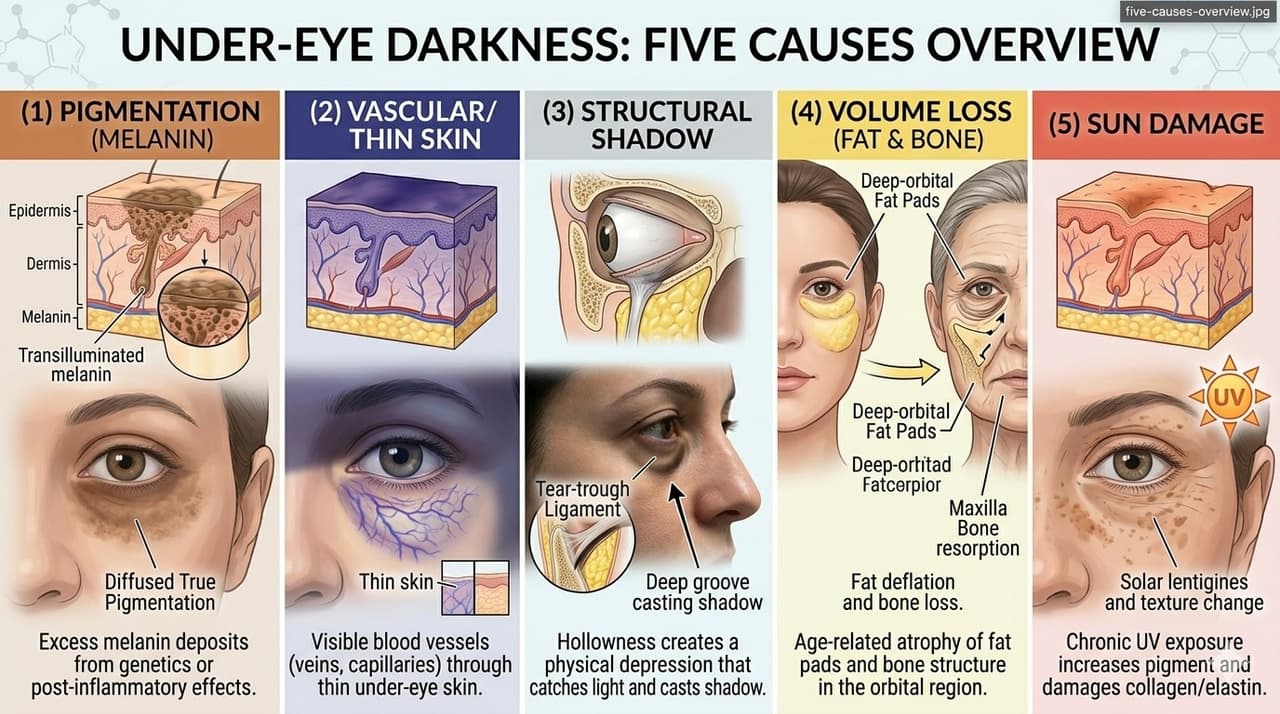
The five causes are: (1) hyperpigmentation, (2) vascular or thin skin, (3) tear trough hollowing, (4) herniated lower lid fat, and (5) festoons and malar mounds. Most patients have two or three of these at the same time.
True hyperpigmentation means there is extra melanin in the skin of the lower eyelid. The skin itself is brown, gray, or bronze, and the discoloration is in the skin rather than showing through it. This is most common in patients with darker skin types (Fitzpatrick III through VI), in patients of South Asian, Mediterranean, Middle Eastern, Hispanic, and African ancestry, and in patients with a strong family history of pigmented lower lids.
Hyperpigmentation can be constitutional (genetic), post-inflammatory (from chronic rubbing, eczema, or allergic shiners), or sun-induced. It is the cause that responds best to skin-directed treatments:
Ablative resurfacing and IPL must be used with great caution in darker skin types because of the real risk of worsening pigmentation through post-inflammatory hyperpigmentation. This is one of the areas where specialist judgment matters most.
The skin of the lower eyelid is the thinnest skin on the body — often less than half a millimeter. In some patients this skin is so translucent that the underlying structures show through. What patients perceive as “dark” is actually the bluish-purple color of the orbicularis oculi muscle and the venous plexus beneath it. Stretch the skin and the “darkness” partially disappears, because you are pulling the translucent skin tighter and changing how light scatters through it.
This cause is often hereditary and is common in patients of Northern European, Celtic, and East Asian descent. It frequently coexists with allergies (the “allergic shiner”), chronic sinus congestion, sleep deprivation, and dehydration — all of which dilate the small subdermal veins.
Treatments aimed at this cause try to either thicken the skin, reduce the visible vasculature, or camouflage the underlying color:
This is the cause that fools the most patients — and the most medspas. The tear trough is the natural groove that runs from the inner corner of the eye downward and outward along the orbital rim. With age (and in many young patients, by genetics alone), the cheek descends and the orbital rim becomes more prominent, creating a depression. The depression itself is not dark. But because it is recessed, ambient light from above casts a shadow into it, and that shadow reads as a “dark circle” to the patient and to the camera.
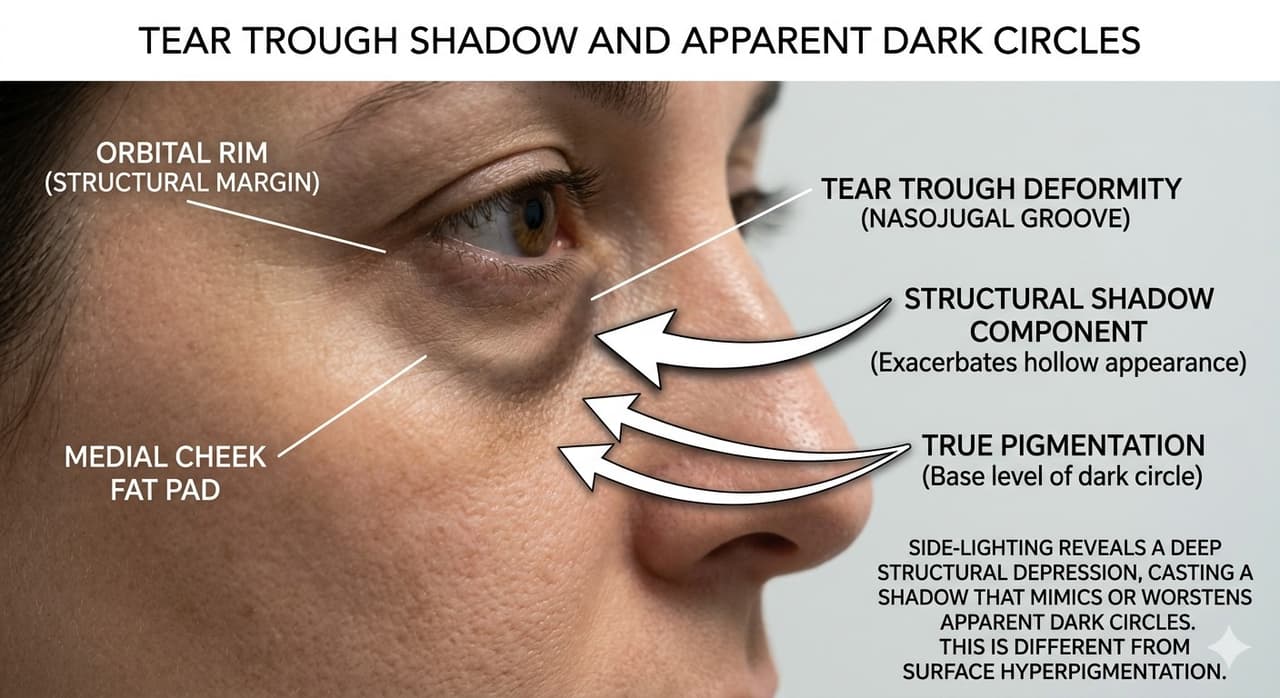
The giveaway: shine a flashlight directly under the eye from below. If the “circle” disappears, it was a shadow, not pigment. This cause does not respond to any topical product — you cannot bleach a shadow. The treatments are volumetric:
Important: Tear trough filler is one of the most technique-sensitive injections on the face. Filler placed too superficially produces a bluish lump (the Tyndall effect), and overfilling produces puffy, swollen-looking lower lids that can last for years. This is not an entry-level injection.
The lower eyelid contains three small fat compartments that cushion the eye. With age — and again, in some patients from a young age — the orbital septum weakens and these fat pads bulge forward, creating “bags” under the eyes. Just like a tear trough hollow, these bags cast a shadow on the skin below them, which the patient perceives as a dark circle. Often there is both a bag (the fat) and a hollow (the tear trough) immediately below it, producing the classic double-contour deformity.
No cream, no filler, and no laser will remove herniated fat. The definitive treatment is surgical:
This is the area where oculoplastic specialists differ most from general cosmetic providers. Removing too much fat creates a hollow, skeletonized look that ages the patient prematurely. Modern technique favors repositioning over aggressive excision, and only an experienced surgeon can judge which compartments need what. See our detailed guide to under-eye bags.
Festoons and malar mounds are puffy, hammock-like swellings that sit on the cheek below the lower eyelid bag, separated from it by a groove (the orbitomalar ligament). They can be fluid-filled (chronic edema), solid (lax orbicularis muscle and skin), or both. Like bags, they cast their own shadow, contributing to the appearance of a dark zone under the eye.
Festoons are notoriously difficult to treat and are the cause most likely to be missed or mistreated. Filler placed into a festoon makes it bigger and heavier. Lasers help the skin component but not the underlying lax muscle. Definitive treatment often requires direct excision, which leaves a visible (though usually well-camouflaged) scar along the cheek. Read our full discussion of festoons and malar mounds.
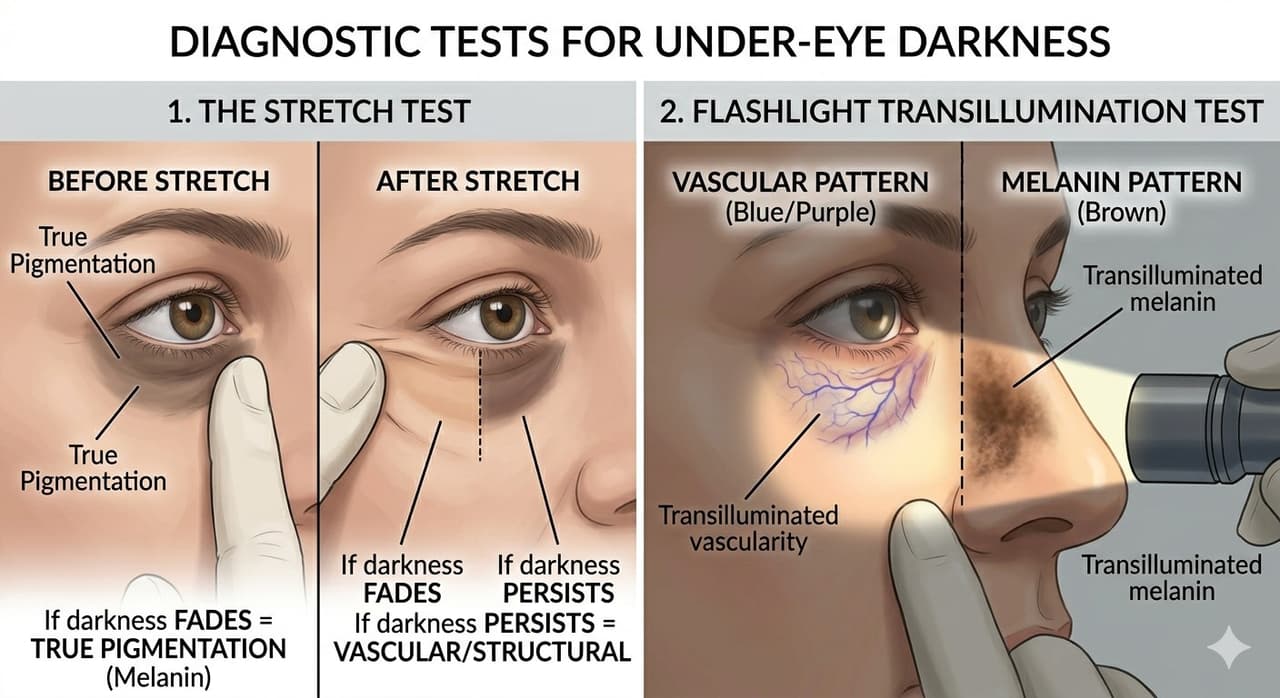
Three simple in-office maneuvers, performed in front of a mirror, will sort out most cases. Patients can try them at home as well to begin to understand their own anatomy.
Place a fingertip on the cheekbone just below the dark circle and gently pull the skin downward and outward, stretching the lower lid skin taut. If the dark color fades or disappears, the cause is vascular or thin-skin related — you are looking through the skin at underlying muscle and vessels. If the color stays the same, the pigment is in the skin itself (true hyperpigmentation).
In a dimly lit room, hold a small flashlight or phone flashlight below the cheekbone and shine it upward toward the eye. This eliminates the overhead shadow that normally falls into the tear trough. If the dark circle vanishes under upward lighting, the problem is shadowing from a tear trough hollow or from a bulging fat pad above it — not pigment. If the darkness persists, the cause is in the skin.
Gently pinch the lower lid skin between thumb and forefinger and lift it slightly away from the eye. Then release. This assesses skin thickness, elasticity, and the presence of bulging fat behind the skin. Very thin, translucent skin that pinches up easily and snaps back slowly suggests both a vascular component and the early skin changes that may benefit from resurfacing or microneedling. Firm fullness that resists pinching suggests herniated fat that needs surgical attention.
The table below summarizes how each cause is identified and which family of treatments is appropriate. Many patients fall into more than one row, and combination treatment is the rule rather than the exception.
| Cause | Key Finding | First-Line Treatment |
|---|---|---|
| Hyperpigmentation | Color stays on stretch test; brown or bronze hue | Topical brighteners, sunscreen, gentle peels, pico laser |
| Vascular / thin skin | Color fades on stretch; blue or purple hue | Vascular laser, IPL, microneedling, dermal thickening |
| Tear trough hollow | Disappears under upward flashlight; palpable groove | HA filler, fat grafting, or surgical fat repositioning |
| Herniated fat | Visible bulge worsened on upgaze; firm fullness | Transconjunctival lower blepharoplasty |
| Festoons / malar mounds | Hammock below the orbital rim; worse with salt or fatigue | Direct excision, laser resurfacing, lifestyle changes |
The reason patients spend years and thousands of dollars on dark circles without improvement is simple: most providers can only offer the treatments they are trained to perform. A medspa with a laser will recommend the laser. An injector with filler will recommend filler. Neither can recommend — or perform — the surgery that some patients actually need. An ASOPRS-trained oculoplastic surgeon is among the few providers specifically trained across the entire continuum: skin, vessels, fat, muscle, and bone of the eyelid and midface.
The difference is not marketing — it is the ability to give you an honest answer about whether a treatment will work. If a patient’s dark circles are 80% tear-trough shadow and 20% pigment, no amount of laser will satisfy them. If they are 80% pigment and 20% structural, surgery will disappoint them. The right starting point is a diagnosis.
You should see an oculoplastic specialist for dark circles when:
A thorough periocular rejuvenation consultation includes evaluation of brow position, upper eyelid skin, midface volume, and tear function — all of which can influence how dark circles appear and how they should be treated.
Dark circles are common, but the path to actually improving them is not generic. A careful look in good lighting, a few simple bedside tests, and an honest discussion of which of the five causes apply to your face will tell you more than any product label. To find a board-certified oculoplastic surgeon in your area who can diagnose and treat all five causes of under-eye dark circles, please Find a Doctor through the ASOPRS directory.
Schedule a consultation with Andrew M. Goldbaum, MD to learn if this procedure is right for you.